Almost everyone arrives at “Yu Garden” expecting one attraction and finds four overlapping ones. Here is what each one is, and which of them you pay for.
豫园 · Yù Yuán
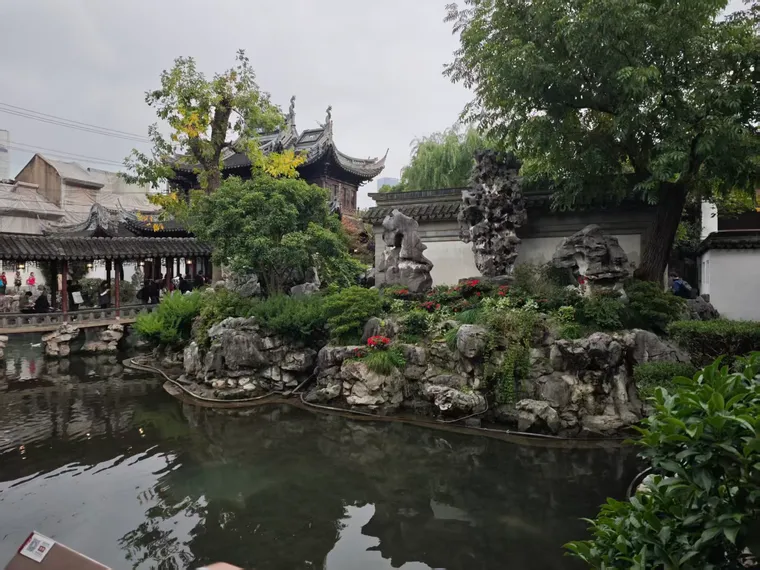
A walled Ming-dynasty private garden, begun in 1559 by Pan Yunduan, an official who built it for his ageing father, Pan En. It took the better part of twenty years. The character 豫 means to please — the whole place is, quite literally, a present to a parent.
Inside you will find rockeries, ponds, halls and covered walkways laid out so that no view opens all at once. Two things are worth finding: the Exquisite Jade Rock (玉玲珑), a pitted limestone monolith counted among the famous scholar’s stones of the Jiangnan region, and the Hall of Heralding Spring (点春堂), which the Small Swords Society used as a headquarters during their rising in 1853.
The garden was damaged again and again — by the Opium War fighting of 1842, by the Taiping years, by the Japanese occupation — restored from the 1950s, and reopened to the public in 1961.
This is the only one of the four that is walled, ticketed and has a closing time. You go in through one gate, and when you come out you are back among the shops.
城隍庙 · Chéng Huáng Miào
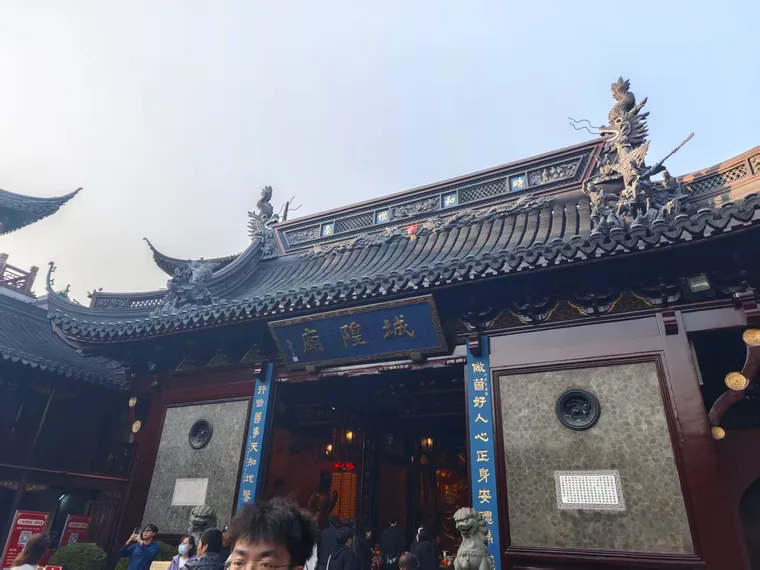
A working Taoist temple, not a museum piece. Shanghai’s City God Temple is unusual in honouring three city gods rather than one: Huo Guang, a Han-dynasty general; Qin Yubo, a scholar-official of the Yuan and early Ming; and Chen Huacheng, the Qing admiral who died defending the Wusong forts in 1842. The site became a City God Temple in the early fifteenth century.
It is small — a courtyard and a handful of halls — and it charges its own admission, separate from the garden. People come to burn incense, not only to look.
The naming trap lives here. In everyday Shanghai speech, 城隍庙 long ago stopped meaning the temple and came to mean the entire district around it. That is why our own postal address reads City God Temple of Shanghai No. 1 Shopping Center — that is a shopping centre named after the neighbourhood. It is not the temple, and we are not in a temple.
豫园商城 · Yù Yuán Shāng Chéng
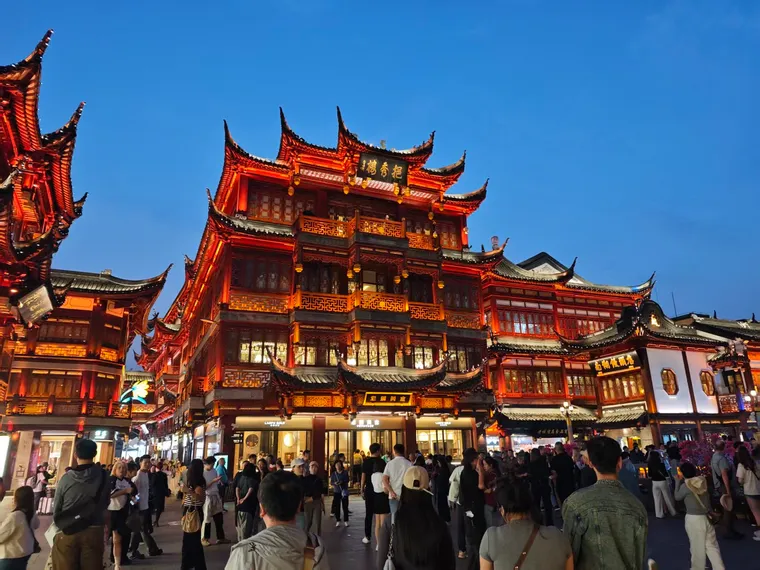
The grey tiles, the upswept eaves, the red-and-gold shopfronts photographed from the Nine-Turn Bridge — this is the bazaar, and it is what most visitors actually mean when they say they are “going to Yu Garden”.
It looks Ming. It is not. Almost all of it is twentieth-century commercial construction, much of it rebuilt and considerably extended through the 1990s, in a deliberate Ming-and-Qing style. Knowing that is not a reason to skip it — it is a handsome piece of streetscape and it is where the life is. It is a reason not to pay antique prices inside a shopping centre.
There is no ticket and no gate. You walk in off the street. Inside it are the Nine-Turn Bridge (九曲桥) and the Huxinting teahouse (湖心亭) standing in the lotus pond, the queue outside Nanxiang’s steamed-bun counter, and several hundred shops over several floors.
We are one of them — Unit 239, second floor, 88 Lishui Road, up the escalator to the left of the McDonald’s.
上海老街 · Shànghǎi Lǎo Jiē
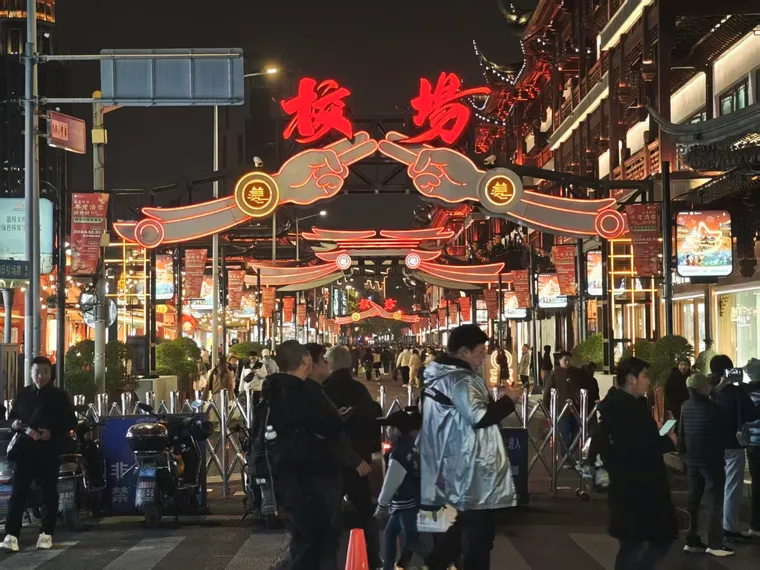
A street rather than a compound: Fangbang Middle Road (方浜中路), running east from the bazaar. It was restored in the late 1990s as a themed old street, and the architecture is staged along its length — late-imperial shopfronts at one end shading into Republican-era frontages at the other.
It is free, it is quieter than the bazaar, and the prices are generally softer, because the coach groups mostly do not walk this far. If the crowd inside the bazaar has become too much, this is the direction to walk.
The single question we are asked most across the counter
| Place | Admission | Walled? | What it is |
|---|---|---|---|
| Yu Garden | Ticketed | Yes — one gate | A Ming garden, 1559 |
| City God Temple | Ticketed, separately | Yes | A working Taoist temple |
| Yuyuan Bazaar | Free | No — open streets | Shops, mostly built in the 1990s |
| Shanghai Old Street | Free | No | A restored street, Fangbang Rd |
Ticket prices and opening hours change, and the garden and the temple sell separately — check both on the day rather than trusting a page written last month. Nothing on this page will ever quote you a price we cannot stand behind.
The worry everybody arrives with, and four questions that settle it
The Old City is a tourist district, and the oldest complaint about tourist districts is the number you get quoted after someone has had a look at you. Four questions sort out most of it, and they work in any shop on any floor here — ours included. Ask them before you ask the price.
Is the price already written down? A shop that decides the number after seeing your face has told you what kind of shop it is.
Does the label give a weight? “¥200 for tea” means nothing. ¥200 for 100 g means something, and lets you compare two shops.
Does it name a place, not just a country? Not “Chinese tea” but Longjing from Hangzhou, Da Hong Pao from the Wuyi cliffs, Pu-erh from a named mountain. Vagueness about origin is rarely an accident.
Can you taste it before you decide? Tea says very little in a description and a great deal in a cup. A shop confident in its leaf will put a kettle on.
We publish all 91 of our teas on this website — price, weight, origin — so you can hold us to those four questions before you come up the escalator, and so we cannot quietly charge a visitor more than a neighbour. Why we price this way · See the whole menu
The two mistakes we watch people make every day
Take exit 7 at Yuyuan metro station. It is the closest, and it brings you past our door — which is how we know.
The bazaar is not the garden. This is the single thing we are asked to untangle most often: people walk the lanes for half an hour looking for “Yu Garden” while standing in the middle of what they think is it. The garden is a walled compound over by the Nine-Turn Bridge, with its own gate and its own ticket. If you cannot find it, ask anybody — ask us.
Do the garden first, while your legs are fresh. It asks more of you than the shops do. Come out, and then wander the bazaar; it is the easier half and it rewards a tired person better.
On our floor, the second, there are several tea shops and the layout is genuinely confusing — some of them are new, we have been here a long time. Look for the number 239, up the escalator to the left of the McDonald’s. Every one of our prices is on this website before you arrive.
From behind a counter, ten till seven, every day
On an ordinary day the crowd builds around mealtimes and then again after dark, when the lanterns come on and the bazaar is at its best-looking and its most crowded at the same time. In between it breathes.
Mondays are quiet, because the garden is usually shut. The bazaar stays open and noticeably empties out. Public holidays are the exception — the garden opens on those Mondays — so check the day before you plan around it.
Chinese public holidays are busy from open to close, with no quiet window at all. The Spring Festival lantern displays are the extreme case: they are beautiful and they are packed. Come for them on purpose, or avoid them on purpose — do not wander into them by accident.
Coach groups mostly arrive in the morning. It matters less than you would think: they move together and they move on.
We would rather you spent your money well than spent it with us
The souvenirs are, honestly, ordinary. There are a great many small-goods shops and the quality is unremarkable and the design is mostly absent. If you want something with a bit of thought in it, a museum shop or a good café’s own merchandise will serve you better; if you want cheap, you will do better online at home than here. Buy what genuinely catches your eye, and do not feel you have to leave with a bag.
Anything sold to you as an antique: learn first, buy later. Please do not make that decision on impulse, in a tourist district, on the day.
Tea has no single correct price. A high number is not proof of quality and a low one is not proof of a bargain. What settles it is the cup. Any decent shop on this floor will let you taste several before you decide — so taste several. Ask for another, and another. We will not hurry you.
The three things nobody writes down and everybody needs
Toilets are plentiful here and generally clean — there is one right beside our shop. This is not somewhere you need to plan around.
Luggage. The self-service lockers inside the metro station run about ¥10–20. Shops on the street outside will ask considerably more, up to around ¥50 for the same service. Use the metro lockers — or just leave your bag with us and collect it when you are done.
Somewhere to sit without buying anything. The McDonald’s downstairs is genuinely fine for this, and the coffee is cheap. We are a tea shop and we are telling you to go and sit in a McDonald’s; that is how strongly we mean it. When it rains, that is also the easiest place in this block to wait it out.
You are closer to two good things than the map suggests
The Bund is walkable. Head along Fuyou Road — or Fangbang Middle Road, or Renmin Road — towards the tall buildings. You cannot really get it wrong: walk towards the skyline.
The Shiliupu wharf is close by, which makes an evening river cruise the natural thing to do after the Old City. Finish here, walk over, and see the same skyline from the water.
Taxis: book through an app. Hailing one on the street here means waiting. If you must wait for one, do it at the entrance to Yuyuan metro station rather than in the lanes.
Asked at this counter more than any other question about tea
We have stopped pretending there is an answer, because our own sales say there isn’t one. Look at what people actually walk out with and it is spread almost evenly across the whole shelf — ripe pu-erh, raw pu-erh, oolong, jasmine, green, black, a fruit blend. Nothing dominates. Two customers in a row rarely buy the same thing.
The deciding happens at the table, not before it. People come in certain they want green tea and leave with a roasted oolong, because one of them tasted like something to them and the other did not. That is not indecision; that is the only reliable way to choose.
So do not decide in advance. Sit down, taste four or five, and notice which one you are still thinking about ten minutes later. That is yours.
A gift is the harder case, because the person receiving it cannot taste first and you are guessing on their behalf. When you are guessing, spread the guess: a set of several small packets fails more gently than one large tin of the wrong thing. Buying for yourself is the opposite — commit to the one you liked.
The question we are asked at the counter after the buying is done
It will not spoil on the journey. We seal what you buy, and sealed tea travels perfectly well — it is dried leaf, not fresh produce.
Customs is your country’s question, not China’s. Rules on bringing in plant products differ from one country to the next, and a few are strict. Check yours before you fly, and if you are carrying a large quantity, declare it. A declared box is a formality; an undeclared one can become a problem.
We are a tea shop on the second floor, Unit 239. Sit down, we brew one tea at two qualities side by side, and you taste the difference before you decide anything. It is free and there is no time limit.